
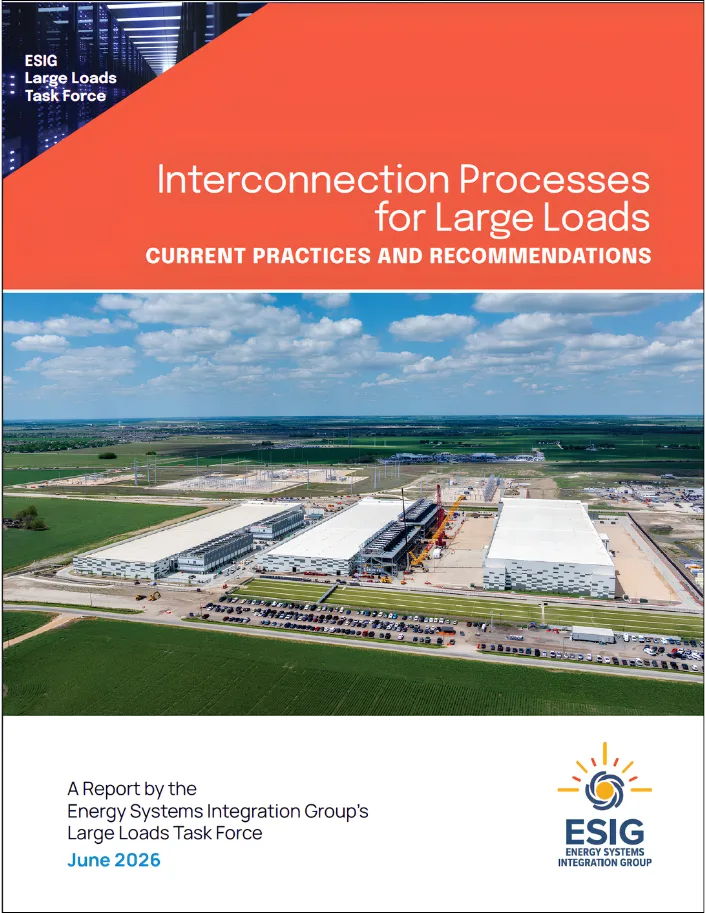
Interconnection Processes for Large Loads: Current Practices and Recommendations is a comprehensive technical assessment of how the U.S. electric power system handles—and often struggles to handle—the surging volume of large load interconnection requests from data centers, advanced manufacturing, and other facilities.
The report, produced by ESIG’s Large Loads Task Force, examines current interconnection practices across utilities and ISOs/RTOs, maps the gaps and bottlenecks driving delays and reliability risk, identifies emerging best practices, and distills a set of recommendations for creating a more comprehensive, transparent, harmonized, and efficient interconnection process. It arrives at a pivotal moment. On June 18, FERC issued show cause orders directing all six RTOs/ISOs to justify or reform how they interconnect large loads, on timelines as short as 30 to 60 days. ESIG’s report offers a technically grounded benchmark of current practice—a way to measure those forthcoming responses against how interconnection actually works today—informed by lessons learned from integrating large amounts of solar, wind, and battery storage in recent years, which posed some of the same challenges we’re seeing now with large loads.
The task force’s findings include that: interconnection processes vary significantly across utilities and regions, with many jurisdictions relying on procedures that were not designed for large load facilities of today’s scale; and coordination between utilities and ISOs/RTOs, where necessary, is inadequate, creating duplicated effort and inconsistent visibility into cumulative system impacts. The question remains unresolved as to which regulatory authorities—FERC, NERC, states, ISOs/RTOs, or utilities—hold jurisdiction over large load interconnection standards and procedures.
The report’s recommendations include:
- The development of a potential FERC Large Load Interconnection Procedure modeled on existing interconnection processes for generation
- Enhanced coordination between utilities and ISOs/RTOs through formal information-sharing protocols and joint study procedures
- Transition to cluster study approaches as the volume of large load interconnection requests grow; inclusion of generation interconnection projects and planned transmission system upgrade/new build projects into one integrated transmission planning study is also recommended
- Clear performance and capability requirements tied to NERC reliability standards
- Expanded availability of flexible interconnection options—including non-firm, surplus, and provisional service—to accelerate large load interconnection where firm service is not immediately available